
Survival Log Farming and Crops
Quick answer
Survival Log farming runs on multi-day crop timers, which makes it an investment rather than a rescue. Plant in the first week and harvests arrive as bought food runs low; plant when you are hungry and the timers will not save you. Crops grow in outdoor beds and in plant-light cultivation boxes, and the lit boxes trade weather-independence for a dependency on your power supply.
Every confirmed Survival Log crop
Nine Survival Log crops are visible growing in a single Day 7 screenshot, each labelled with a live countdown. Several more appear as ingredients in freezer storage, which implies a wider seed list than one base can display at once.
| Crop | Timer shown | Where grown |
|---|---|---|
| Garlic | 08:44 | Outdoor bed |
| Beet | 13:31 | Plant-light box |
| Spinach | 13:51 | Outdoor bed |
| Carrot | 1D 03:50 | Plant-light box |
| Bell Pepper | 2D 00:31 | Outdoor bed |
| Strawberry | 2D 00:57 | Planter |
| Onion | 2D 02:56 | Outdoor bed |
| Pumpkin | 2D 07:45 | Large container |
| Watermelon | 3D 07:06 | Enclosed grow frame |
These are remaining times captured in one frame, not total growth durations. They were planted at different moments, so the table shows the spread of Survival Log crop cycles rather than a definitive seed-to-harvest figure for each. What it establishes reliably is the scale: multiple days, not hours.
Additional produce appears in the cooking storage tabs - cabbage, tomato, potato, radish, green onion, peas and mushrooms among them - so the Survival Log farming roster is broader than any single base layout will show.
Survival Log outdoor beds versus plant lights
| Method | Cost | Weather | Risk |
|---|---|---|---|
| Outdoor beds and planters | Low | Exposed | Cold and rain interrupt growth |
| Plant-light cultivation boxes | Higher, plus power draw | Independent | A blackout wastes invested days |
| Hydroponic station | High | Independent | Slot and power hungry |
The Survival Log farming trade-off is genuinely interesting because neither option is safe. Outdoor beds are free but hostage to weather, and cold waves arrive exactly when you want food security. Lit boxes ignore the sky but tie your harvest to the same diesel or solar decision that everything else depends on.
The balanced approach most successful Survival Log runs converge on: outdoor beds for bulk staples where losing a cycle is survivable, and lit boxes for the crops you actually need on schedule.
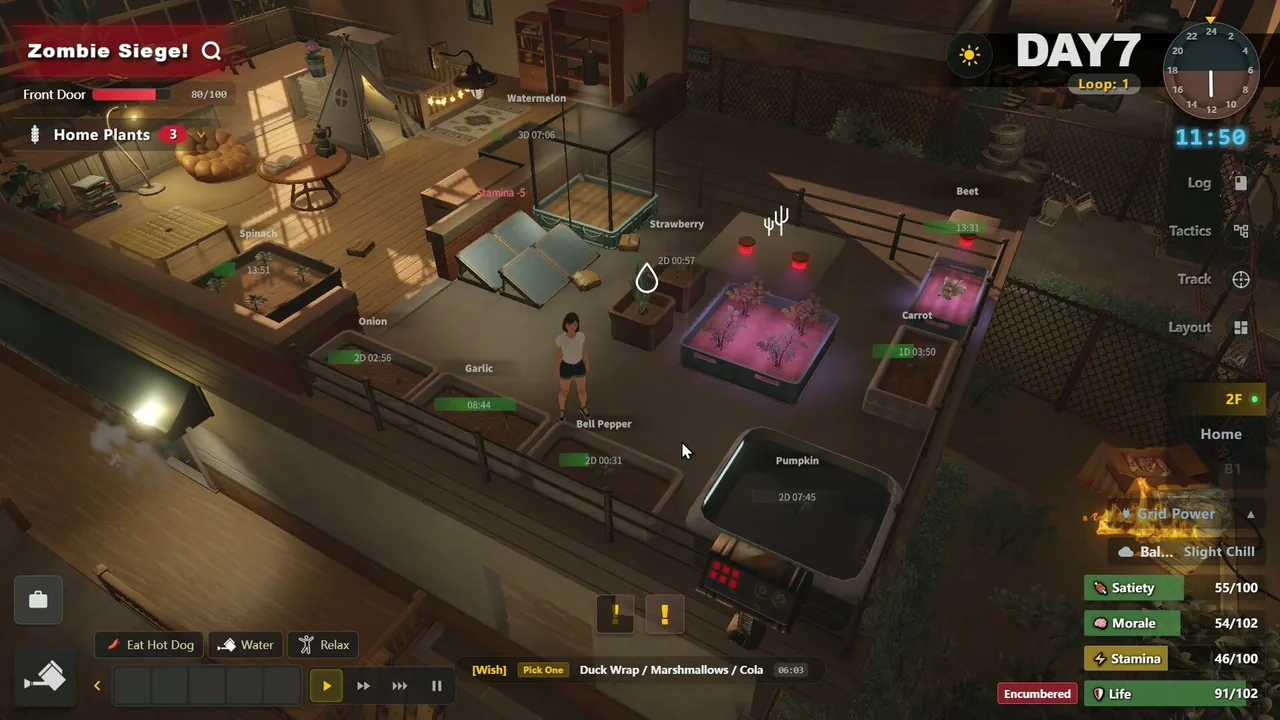
Survival Log farming costs daily actions, not just space
Watering appears as a discrete action in the action bar, which means every planting you add is a recurring claim on your daily budget. A Survival Log garden that outgrows the attention you can give it produces less than a smaller one you actually maintain.
A Survival Log Home Plants counter tracks how many plantings are active - one screenshot shows three. Treat that number as a workload indicator rather than a score. Three well-watered crops beat eight neglected ones, particularly when a siege week leaves you with almost no spare capacity.
When to plant in Survival Log
- Days 1-4: plant everything you can. With multi-day Survival Log cycles, the first week is the only planting window that matters for the second.
- Days 5-10: build lit Survival Log capacity. If power is stable, add plant-light boxes so the first cold snap does not reset your progress.
- Days 10+: harvest and replant immediately. An idle Survival Log bed earns nothing. An empty bed is wasted days. Replant on the same visit rather than making it a separate job.
- Survival Log siege weeks: reduce scope. Stop expanding. Water what exists and put the spare capacity into defense.
The underlying rule for Survival Log farming is that crops convert time you have now into food you get later. That is a fantastic trade in week one and a worthless one in week five, which is why farming belongs in your prep planning rather than in your emergency response.
Survival Log FAQ: Farming & Crops
What crops can you grow in Survival Log?
Confirmed from official screenshots: watermelon, spinach, onion, garlic, bell pepper, strawberry, beet, carrot and pumpkin, with cabbage, tomato, potato, radish, green onion, peas and mushrooms appearing in storage.
How long do Survival Log crops take to grow?
Days, not hours. Planting boxes show countdown timers, and observed remaining times in a single Day 7 screenshot range from about 8 hours to over three days - which means anything you want on Day 14 has to be planted in the first week.
Are plant lights worth it?
Yes, because they make growth weather-independent. The trade-off is that lit cultivation boxes depend on your power supply, so a blackout costs you the days already invested.
When does farming start paying off?
Around the second week, if you plant in the first. Survival Log farming is an investment with a multi-day lag, so it rescues nothing if you start it when food runs low.