
Survival Log Stockpile and Item Database
Quick answer
A Survival Log stockpile is judged on three numbers per item: price, weight in kilograms, and grid footprint. Cheap, light, small items with real utility are what fill a good hoard; expensive bulky consumables are what fill a bad one. This page collects every verified item stat, sorted into must-buy, optional and skip.
The Survival Log stockpile is not a shopping list, it is an allocation problem. You are spending three separate budgets - cash, carry weight and typed home slots - and an item can be cheap on one while ruinous on another. The tables below show all three at once.
Verified Survival Log item stats
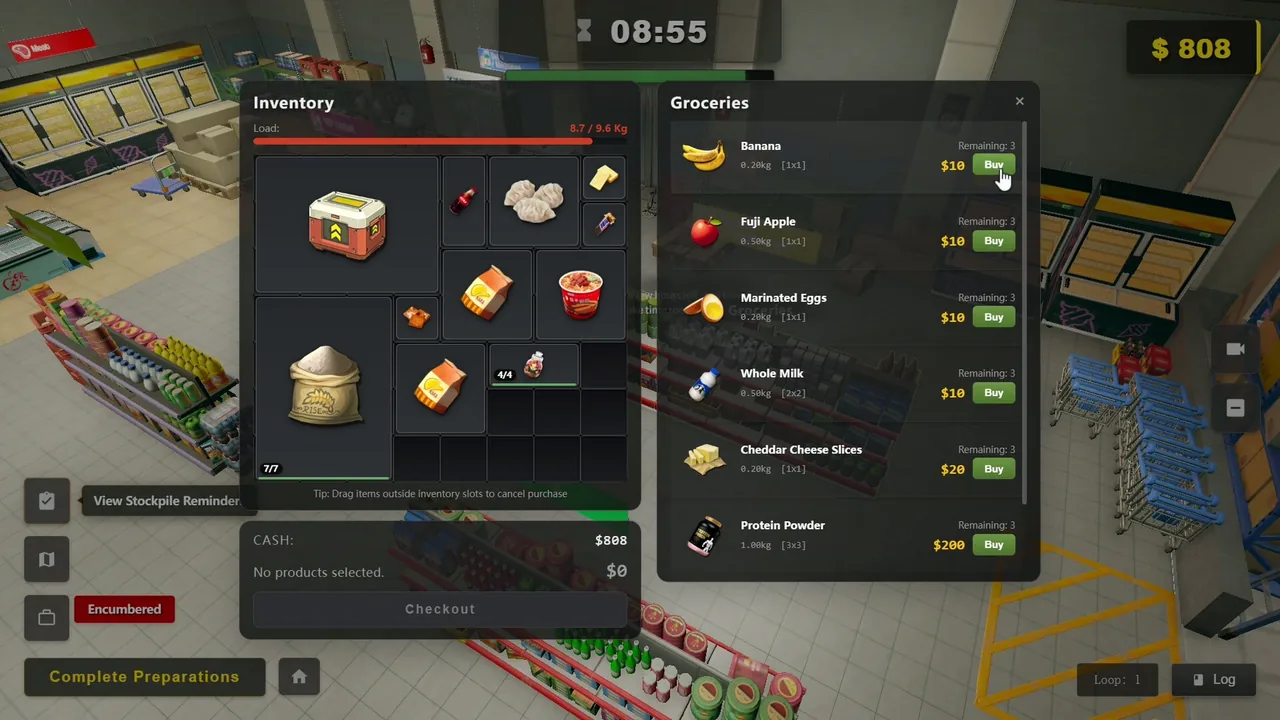
| Item | Price | Weight | Grid | Slot | Verdict |
|---|---|---|---|---|---|
| Banana | $10 | 0.20 kg | 1x1 | - | Must-buy |
| Marinated Eggs | $10 | 0.20 kg | 1x1 | - | Must-buy |
| Fuji Apple | $10 | 0.50 kg | 1x1 | - | Optional |
| Whole Milk | $10 | 0.50 kg | 2x2 | - | Optional |
| Cheddar Cheese Slices | $20 | 0.20 kg | 1x1 | - | Optional |
| Protein Powder | $200 | 1.00 kg | 3x3 | - | Skip |
| Microwave | $20 | - | - | Tabletop | Must-buy |
| Juicer | $10 | - | - | Tabletop | Optional |
| Electric Oven | $120 | - | - | Small | Optional |
| Large Storage Rack | - | - | - | Large | Must-buy |
| Wooden Bed | - | - | - | Bed | Must-buy |
| Security Door | - | - | - | Door | Must-buy |
| Security Window | - | - | - | Window | Must-buy |
Two readings jump out. First, weight efficiency varies wildly at identical prices - a banana and an apple both cost $10, but the apple weighs 2.5 times as much. Second, grid footprint is a hidden tax: Whole Milk costs the same $10 as a banana while occupying four times the grid space.
The microwave is the best purchase in the game
Worth isolating because the numbers are unusually clear. The Survival Log microwave costs $20, occupies a tabletop slot, installs in 1m 40s, and lists these stats:
| Stat | Value |
|---|---|
| Cooking mode | Auto - no supervision needed |
| Max ingredients | 3 |
| Max seasonings | 1 |
| Power consumption | 30 W |
| Cooking speed | 1x |
| Quality bonus | +0 |
"Auto" is the key line. Unattended cooking means the appliance produces morale-restoring meals without consuming the attention that everything else in a Survival Log day competes for. At $20 and 30 W, it is the cheapest conversion of raw hoard into usable survival value in the game.
All Survival Log stockpile guides
Food & water
How much you actually need to reach the late game, and why variety is forced on you by stock caps.
how much food · water · caloriesCooking & recipes
393 recipes, fuel queues, fridge and freezer storage, and cooking as a morale system.
recipes · cooking · morale foodFarming & crops
Every crop seen in-game with its growth timer, plus whether hydroponics pays for itself.
crops · seeds · farmingReading the three Survival Log budgets
Before the tables are useful, it helps to know which budget binds first. In a typical Survival Log prep phase the order is almost always the same: carry weight runs out before cash, and typed home slots run out before either when you start buying furniture. That is why the item tables here list weight and slot alongside price - an item that is cheap in dollars can still be the most expensive thing you buy that trip.
The corollary is that price comparisons on their own are misleading. Two $10 items are not equivalent if one is 0.20 kg at 1x1 and the other is 0.50 kg at 2x2. Judge every Survival Log purchase on all three axes, and the shopping list reorders itself immediately.
Stock caps change how you shop
Grocery item cards in Survival Log display a remaining count, commonly "Remaining: 3". This single mechanic invalidates the instinct most survival-game players bring with them - find the best calorie-per-dollar item and buy it out.
You cannot. Your Survival Log stockpile will be varied whether or not you planned for variety, which has a useful side effect: you will have the ingredient range that the cooking system needs. Fight the cap and you waste time; work with it and you arrive home with a pantry that can actually produce recipes.
Survival Log FAQ: Stockpile
What should I stockpile first in Survival Log?
Fortification and fuel, then calories, then cooking appliances. Food can be supplemented by scavenging and farming later; door tiers and diesel cannot be improvised once the streets close.
Do Survival Log shops have limited stock?
Yes. Item cards show a remaining count - commonly three per grocery item - so you cannot solve a food shortage by buying twenty of the cheapest thing.
What is the most overrated purchase?
Protein Powder at $200 for a single 1.00 kg, 3x3 item. It consumes a fifth of a typical starting budget and a large block of grid space for one consumable.
What is the best cheap appliance?
The microwave at $20. It takes a tabletop slot, installs in 1m 40s, draws only 30 W, and handles up to 3 ingredients automatically without supervision.