
Survival Log Guides
Quick answer
Every Survival Log guide on this wiki is organised by run stage rather than by system, because that is how the game actually pressures you. Ten hours of shopping decide the run, the first week tests whether your shopping list was right, the middle stretch is economy and power, and the late sieges are pure defense math. Start with how to play if this is your first run.
The Survival Log run, stage by stage
Most guides for this game are organised into topics like "cooking" and "farming". That reads well but plays badly, because Survival Log is a game about when you do things, not just what you do. This table is the spine of the whole guide section.
| Stage | Your job | What kills runs here | Guide |
|---|---|---|---|
| Prep (10 hours) | Spend cash and carry weight on the right categories | Buying variety instead of essentials; leaving items uninstalled | Prep checklist |
| Days 1-7 | Establish routine: cook, sleep, board up, don't overspend stamina | Morale collapse; no power plan | How to play |
| Days 8-30 | Farm, cook properly, upgrade doors and windows, build traps | Fuel running out; sieges outpacing defense | Base guides |
| Days 31-50 | Hold escalating sieges through rain and cold | Blackout during a cold wave; door durability collapse | Late sieges |
| After the run | Convert failure into a better next loop | Treating a wipe as the end | Time loop |
All Survival Log guides on this wiki
Six pages cover the whole run. Read them in order for a first playthrough, or jump straight to the stage where your Survival Log run keeps collapsing.
How to play
The five-step opening, the four meters, and the mistakes that end most first runs before Day 7.
how to play survival log · beginnerFirst 10 hours
The prep checklist: what to buy, in what order, how to split cash, and what is safe to skip.
what to buy first · prep checklistTime loop & New Game Plus
How loops work, what carries over, and what happens when you run out of them.
time loop · new game plus · loopsPlanning Points
The daily action budget, why leftover points are a warning sign, and how meters throttle it.
planning points · daily actionsDifficulty modes
Which difficulty to pick, what changes, and how the hardest self-imposed runs are actually done.
difficulty · hardest modeDay-by-day walkthrough
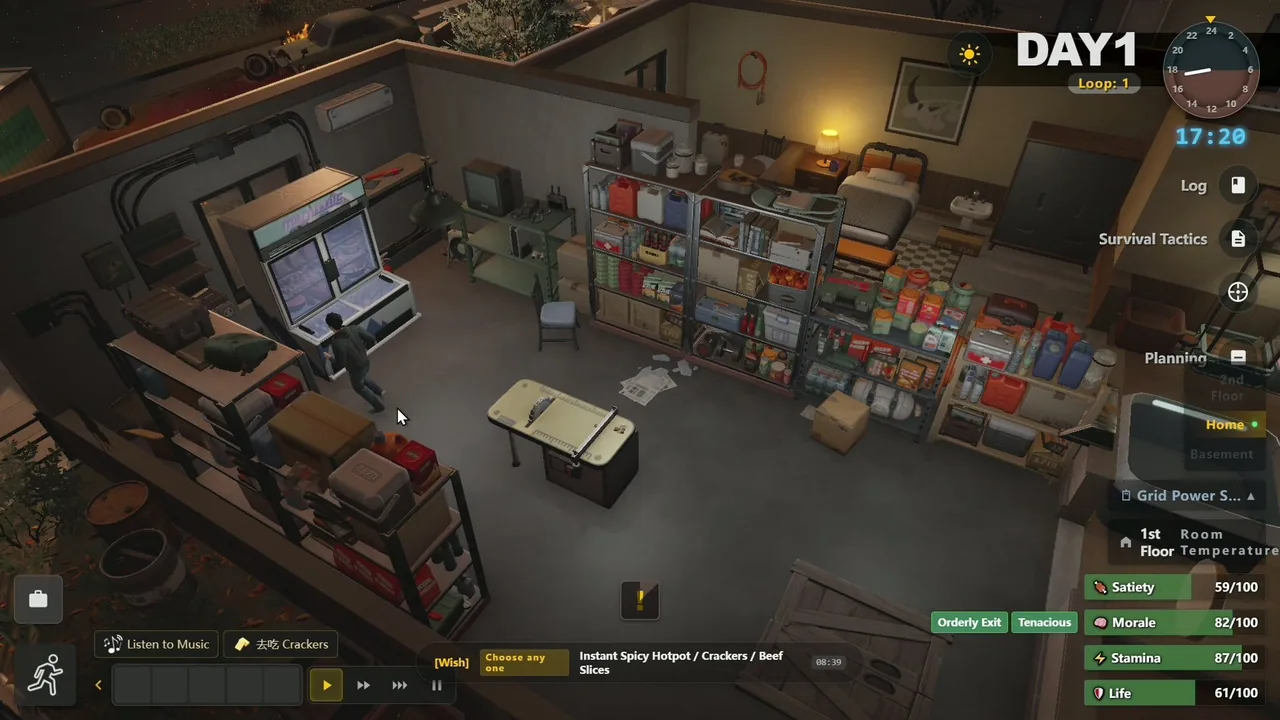
A concrete schedule from Day 1 to the final siege, plus the interface controls worth learning early.
walkthrough · day by day · controlsThe five things every Survival Log guide should tell you first
- In Survival Log, buying is not the same as owning. Furniture and appliances have installation times. A microwave takes 1m 40s to install. Anything you buy in the last minutes of the prep clock may still be in a box when the outbreak hits.
- Weight is the real budget. Cash runs out, but in Survival Log carry weight runs out faster. The Encumbered state appears constantly during shopping, and every item carries both a kilogram value and a grid footprint.
- Home slots are typed and finite. Small, medium, large, wall-hanging, tabletop, bed, door and window slots are counted separately. You cannot solve a slot shortage with money.
- Morale is a resource in Survival Log, not a mood. It sits alongside Satiety, Stamina and Life, and it falls when you eat badly and never rest. Efficient-looking runs die of morale.
- Power decides the late game. This is the single most common way a promising Survival Log run ends. Solar is free but weather-dependent; diesel works in rain but burns fuel you had to buy in hour nine. The power guide is the one to read before Day 10.
Values quoted across the Survival Log guide section - durability figures, item prices, power draw, recipe counts - are read from the game's own interface in published screenshots, or marked as community-reported. Where a figure is uncertain, the page says so rather than rounding a guess into a fact.
Survival Log FAQ: Guides
Where should a complete beginner start?
Read How to Play Survival Log first, then the prep checklist. Those two pages cover roughly 80% of what decides whether a first run survives past Day 7.
How long is one Survival Log run?
An evening or two of real time. Runs are looped, so the intended experience is several runs rather than one long session.
Do I need to restart to try a different character?
Yes - the background is chosen at the start of a run. Because knowledge and unlocks persist across loops, switching backgrounds later in your save is far less costly than it sounds.
Is there a right way to play Survival Log?
There are several viable approaches, but only one universal rule: whatever you fail to buy in the first ten hours, you will spend the rest of the run compensating for.