
Survival Log Build Archetypes
Quick answer
Survival Log builds are self-imposed run structures rather than character loadouts. The four the community actually plays are the passive low-action run, the zero-loop clear, restraint runs targeting specific achievements, and ending-hunting runs that deliberately under-develop. Each is decided at the character-select screen, because every one of them changes what you buy during the prep phase.
There is no build screen in this game. What players call Survival Log builds are commitments - a rule you adopt before the clock starts that reshapes every purchase and every day afterwards. Understanding the four common ones is mostly useful for knowing which run you are currently in, because a run without a chosen shape tends to hedge and finish nothing.
The four Survival Log build archetypes
| Archetype | Core rule | Prep priority | Difficulty |
|---|---|---|---|
| Passive / low-action | Minimal daily management | Maximum infrastructure up front | Hard to plan, easy to play |
| Zero-loop clear | No accumulated loop advantage | Perfect first-time shopping | Hardest |
| Restraint run | A spending or durability cap | Deliberately constrained | Hard |
| Ending hunt | Match a specific ending's conditions | Whatever that ending requires | Varies |
The passive build
Community guides describe surviving roughly a hundred days with minimal active play, and it is the most misunderstood of the Survival Log builds. It sounds like an easy mode. It is not - it moves the entire difficulty into the planning phase.
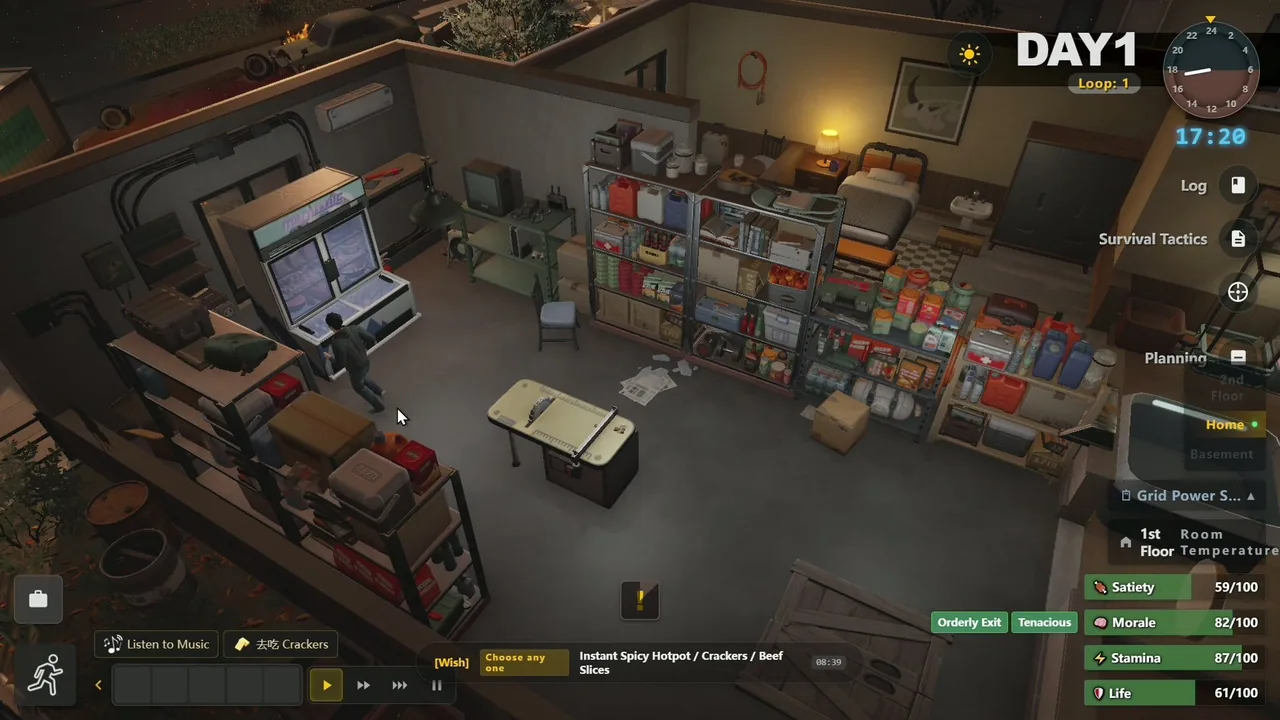
To play passively you need every future problem solved in advance: a power source and fuel buffer that lasts without intervention, door and window tiers high enough to absorb sieges without constant repair, and food systems that need almost no attention. Get any of those wrong and the run collapses precisely because you are not watching it.
What it is genuinely good for: understanding which Survival Log systems are load-bearing. A passive run fails at exactly the point where your infrastructure was thinnest, which is a very clear diagnostic.
The zero-loop clear
The hardest recognised format. You clear the game without leaning on the loop system for unlocks and accumulated knowledge - effectively a first-attempt run, usually on the highest difficulty.
What makes it brutal is that Survival Log is explicitly designed around iteration. Strip out the accumulated recipe book, the unlocked equipment and the memory of shop stock, and every prep decision has to be right the first time. It is less a test of execution than of whether you have genuinely internalised the game's economy. Read the prep checklist and the durability values before attempting one.
Restraint and ending-hunt runs
These two overlap heavily. Restraint runs target achievement conditions - spending under half your prep-phase cash, or holding door and window durability above roughly 70% for a whole run. Ending hunts target a specific outcome, and at least one documented Survival Log ending requires refusing to craft, never installing a generator, and staying indoors after Day 7.
Both share a property that makes them awkward: you cannot tell mid-run whether you are succeeding, because the failure condition is something you did rather than something that happened to you. The discipline is front-loaded, and there is no feedback until the end.
Before starting a restraint or ending Survival Log run, write the single rule somewhere visible. Under pressure on Day 20, "I think I was supposed to not do this" is how these attempts get quietly broken.
Which build to play, and when
- Loops 1-3: no build at all. Learn the Survival Log economy. Archetypes are refinements on knowledge you do not have yet.
- First clean clear: play to win. Prove you can reach the late sieges before adding constraints.
- Then restraint runs. The achievement conditions are the most concrete goals available.
- Then ending hunts. Including the deliberately under-developed ones that an optimised player finds hardest.
- Last: the zero-loop clear. It is the natural graduation test for everything the other Survival Log builds taught you.
Survival Log FAQ: Builds
What is an AFK build in Survival Log?
A deliberately passive run that front-loads infrastructure so the mid-game needs almost no active management. Community guides describe surviving around a hundred days this way, relying on prep-phase investment rather than daily decisions.
What is a zero-loop run?
Clearing the game without using accumulated loop advantages - effectively a first-attempt clear on high difficulty. Community guides for this exist and it is considered the hardest way to play Survival Log.
Is there a best build?
No, because the game measures different things in different runs. A build that maximises survival is locked out of endings that require having built almost nothing.
What build should a new player use?
None. Survival Log builds are refinements on knowledge you do not have yet - play a straightforward run first, then pick an archetype for your second or third loop.