
Survival Log Planning Points Explained
Quick answer
Survival Log Planning Points are a daily action budget that resets each day and does not carry over. Everything meaningful - cooking, crafting, fortifying, farming, going outside - competes for the same pool, so each Survival Log day is a forced prioritisation rather than a to-do list. Ending a day with points left is a sign you hesitated, not a sign you were efficient.
Why a daily cap changes everything
Without Planning Points, Survival Log would be a game about having enough materials. With them, it becomes a game about attention. You will routinely have the timber, the tools and the intention to reinforce a window, and simply not have the day left to do it.
That constraint is what makes the prep phase matter so much. Everything you bought during the first ten hours is work you do not have to spend Survival Log Planning Points on later. A pre-installed generator is a permanent saving; a generator bought but never installed becomes a debt paid out of a future day's budget.
What competes for your Survival Log day
| Action | Pays off | Becomes urgent |
|---|---|---|
| Cooking a proper meal | Same day - Satiety and Morale together | When Morale slides under half |
| Reinforcing doors and windows | Days later, during a siege | Before the next scheduled attack |
| Crafting traps and barricades | Days later | Once sieges outpace door durability |
| Farming and watering | Multi-day crop timers | Early - crops take days to mature |
| Exploring outside | Immediate loot, real risk | Early, while streets are passable |
| Resting and leisure | Restores Stamina and Morale | Sooner than most players think |
Notice how many rows pay off later. That is the trap of the system: the actions that feel urgent are the ones with same-day payoff, while the ones deciding whether a Survival Log run survives Day 30 all look postponable.
The one-thesis-per-day method
The most reliable way to spend Survival Log Planning Points is to commit each day to a single outcome and let secondary tasks fit around it. Name the day before you start it:
- Fuel day. Everything serves the power buffer - fetch, install, secure.
- Wall day. Boarding, reinforcing, upgrading a door or window tier.
- Kitchen day. Batch cooking to bank Morale and Satiety for days you cannot cook.
- Garden day. Planting and watering, front-loaded so crop timers finish before you need them.
- Materials day. A calculated trip outside to solve a specific shortage, not a general shopping tour.
This works because it converts a scattered list into one criterion. When a competing option appears mid-day, the question stops being "is this useful?" - almost everything in Survival Log is useful - and becomes "does this serve today's thesis?"
How Stamina and Morale throttle the budget
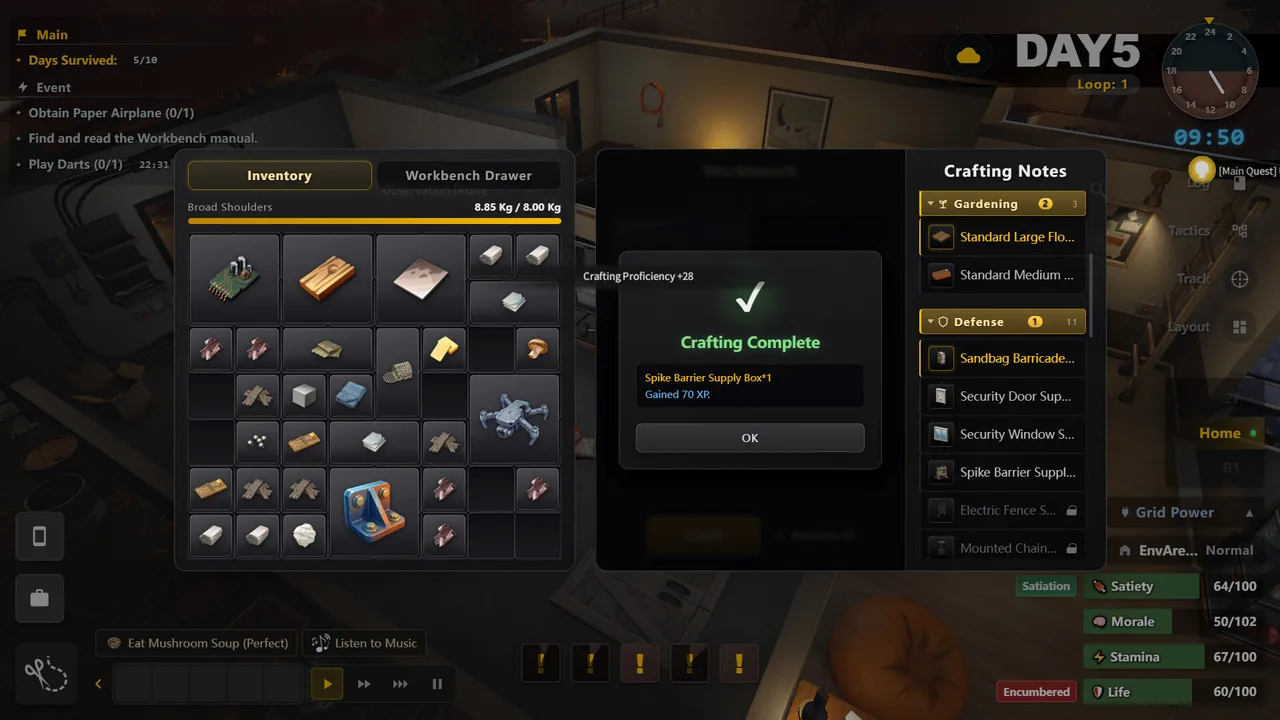
The count of Planning Points is not the whole story. Low meters make execution slower and less effective, so the same nominal budget buys less work. A Survival Log day begun at 46/100 Stamina is not the same day as one begun at 87/100, even when the point total is identical.
This produces the death spiral that ends most mid-game runs: you skip rest to get more done, your meters sag, effective output per point falls, so you skip rest again to compensate. Screenshots of struggling Survival Log runs show the signature clearly - Satiety, Morale and Stamina all sitting in the 40s and 50s at once.
If two of your four meters are below half, spend an action on recovery before spending one on productivity. In Survival Log, resting is not lost time - it is the cheapest way to raise the value of every remaining point in the day.
Reading leftover points as a diagnostic
Leftover Planning Points are the most useful feedback Survival Log gives you, because they almost always mean one of three specific things. You lacked a material and could not start the job - a prep-phase failure. You could not decide between two options and did neither - a planning failure. Or you finished early and did not queue a follow-up - a habit failure.
All three are fixable, and all three stay invisible unless you look at the end-of-day state. Players who improve quickly at Survival Log tend to check that leftover count every evening and treat it as a score for the day.
Survival Log FAQ: Planning Points
What are Planning Points in Survival Log?
Planning Points are the daily action budget. They cap how many meaningful things you can do in a single Survival Log day, forcing a choice between cooking, crafting, fortifying, farming and going outside.
Is it bad to end a day with unused Planning Points?
Almost always. Unspent capacity does not bank - it evaporates. A Survival Log day that ends with points left over usually means you hesitated over a decision instead of committing to one.
How do I get more Planning Points?
Indirectly, by keeping Stamina and Morale healthy. Low meters make actions slower and less effective, which shrinks what your budget actually buys even when the number stays the same.
What should I spend Planning Points on early?
Fortification and power in the first week, cooking and farming once those are stable. Survival Log punishes leaving door and window upgrades until a siege makes them urgent.