
How to Play Survival Log
Quick answer
To play Survival Log well, treat the ten-hour prep phase as the whole game and everything after it as consequences. Pick a background, spend on food, water, fortification and fuel before anything optional, install every purchase before the clock runs out, then settle into a daily routine that keeps all four meters alive. Your first run will probably fail, and that is how the game teaches you.
The five-step Survival Log opening
If you only remember one thing about how to play Survival Log, make it this sequence. It is the same on every difficulty and with every background.
- Choose a background. Survival Log offers worker, college student or warehouse clerk. They differ in starting cash, carry capacity and skill affinities rather than being cosmetic. For a first run, pick whichever gives you the most forgiving carry weight - shopping is where beginners struggle. Full comparison.
- Shop essentials before variety. Survival Log stocks its shops with tempting comforts, and the prep clock makes browsing feel productive. It is not. Food, water, fortification and fuel first; a coffee machine is a Day 20 problem.
- Install everything before the clock ends. This is the mistake that catches almost everyone once. Appliances take real installation time and consume typed home slots, so leave yourself a buffer instead of shopping until the final minute.
- Build a daily routine. After the outbreak, each Survival Log day is a small budget of actions. Cook, eat, sleep, and complete one improvement task. Consistency beats ambition in the first week.
- Solve power before Day 10. Decide whether you are running diesel or solar and act on it. Blackouts are not an inconvenience in Survival Log - they cascade into spoiled food, cold, and morale collapse.
The four meters, and how they interact
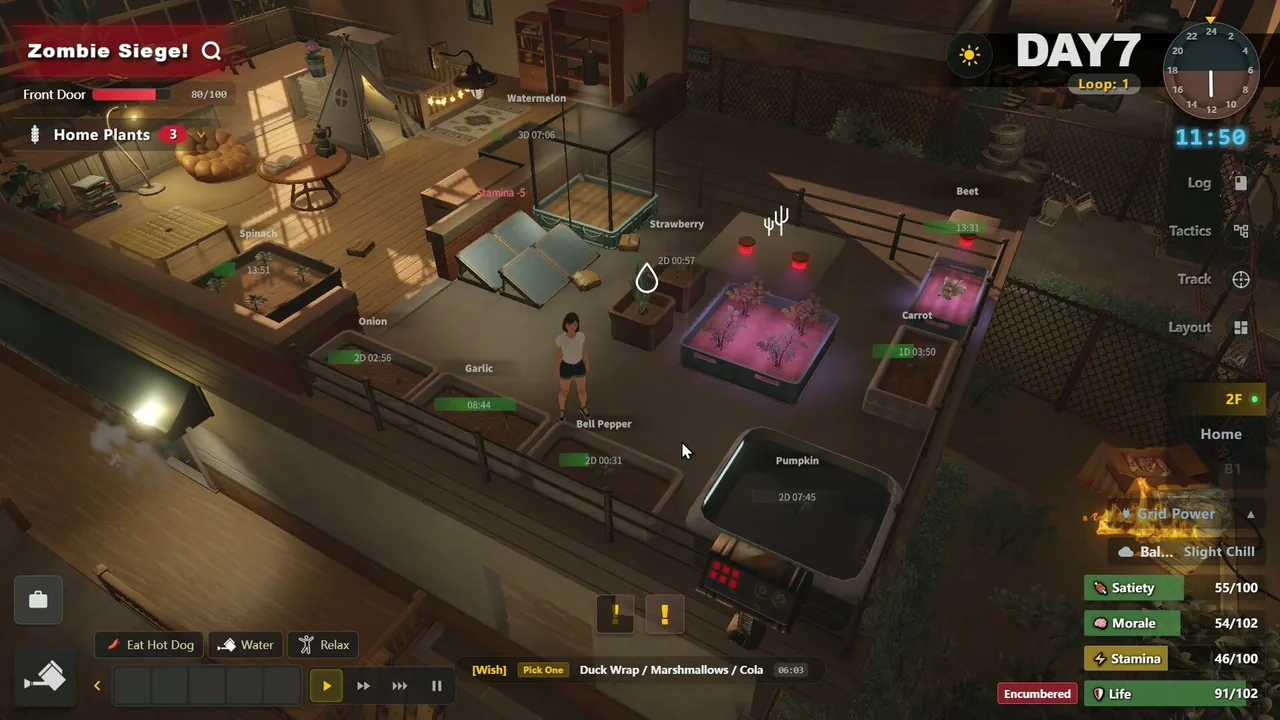
Most survival games give you a health bar and some modifiers. Survival Log instead runs four values at once, visible permanently in the corner of the HUD, and they do not substitute for one another.
| Meter | What drains it | What restores it | Beginner error |
|---|---|---|---|
| Satiety | Time, activity | Eating; better meals restore more | Eating only raw snacks |
| Morale | Bad food, no rest, grim events | Cooked meals, music, leisure actions | Ignoring it entirely |
| Stamina | Work, crafting, carrying, going outside | Sleep and rest | Spending it all on one big day |
| Life | Injury, sustained neglect of the others | Slow recovery when the rest are healthy | Treating it as a health bar to top up |
The Survival Log interaction that catches new players: Life does not recover on demand. It climbs back only when Satiety, Morale and Stamina are in decent shape, so a run that grinds all three down keeps taking damage it cannot heal. Screenshots from mid-run saves routinely show Life sitting around 60/100 while the player is nominally "fine".
Five mistakes that end most first Survival Log runs
- Shopping for variety. This is the number one beginner error in Survival Log. A broad, interesting stockpile loses to a boring, sufficient one. Depth in one category beats a sample of everything.
- Ignoring installation time. Buying a generator at hour nine and not installing it means you own a box, not power.
- Skipping doors and windows. Fortification feels abstract while the Survival Log streets are still quiet. Then the first siege chews through a stock door and the run is over in a day.
- Letting morale slide. It is the least visible failure. You keep eating, you keep working, and your efficiency quietly collapses.
- Treating a wipe as failure. Survival Log is loop-structured. A dead run that taught you the shopping list is a successful run.
How to play Survival Log better on run two
The second attempt is where people start to understand how to play Survival Log properly, because you now know what you ran out of. Write down - genuinely, on paper - what killed you: fuel, food, door durability, morale, or time. Then over-correct on exactly that one thing in the next prep phase and leave everything else the same. One variable at a time converts a wipe into information.
Beyond that, three habits separate surviving Survival Log players from stalling ones. Finish each day with your action budget spent rather than banked, since unspent capacity is capacity wasted - see Planning Points. Upgrade doors and windows before you feel you need to, because upgrades take materials and time you will not have mid-siege. And treat the first cold, rainy stretch as the real exam: it is when power, food and morale get tested at once.
Survival Log FAQ: Beginner Questions
What should I do first in Survival Log?
Choose a background, then spend the ten-hour prep clock on food, water, fortification and fuel in that order. Optional comforts come after the essentials are covered.
Is my first Survival Log run supposed to fail?
Usually, yes. Runs are looped and knowledge carries forward, so an early wipe is the intended teaching mechanism rather than a mistake.
What are the four meters in Survival Log?
Satiety, Morale, Stamina and Life. They move independently: eating fixes Satiety but not Morale, resting restores Stamina but not hunger, and Life only recovers when the other three are healthy.
How many days do you have to survive?
The run escalates through scheduled sieges, with a major horde around Day 50. Early main objectives are shorter - one screenshot shows a 'Days Survived: 5/10' goal - so the game gives you nearer targets to work toward first.
Should I go outside to scavenge?
Early on, yes, carefully. Later, the risk curve turns sharply against you. Read exploration risk before planning a late-run trip.