
Survival Log Walkthrough, Day by Day
Quick answer
A Survival Log run stages its pressure: quests and small events in the first days, the first sieges by Day 7, multi-part swarms by Day 16, and escalation toward a major horde around Day 50. This Survival Log walkthrough gives each stretch one job, because trying to advance everything at once is what exhausts your daily action budget.
The Survival Log day structure
Every Survival Log day runs on a 24-hour dial shown top-right, with the current day and loop number beside it. You act, time passes, meters move. The rhythm that works is simple and worth stating plainly: wake, eat, complete the day's main job, handle upkeep, sleep before your Stamina bottoms out.
| Days | Your one job | Known events | Failure mode |
|---|---|---|---|
| Day 1 | Finish installs, set the routine | Early quest chains begin | Starting projects instead of finishing installs |
| Days 2-5 | Quests and first fortifications | Rescue the Neighbor Girl; send food; small side tasks | Ignoring quests that gate later help |
| Days 5-10 | Hit the staged survival goal | 'Days Survived: 5/10' style objectives | Overspending stamina on long trips |
| Day 7 onward | Door and window durability | Zombie Siege - front door drops to 80/100 | First siege arriving before upgrades |
| Days 10-20 | Power, farming, cooking stability | Undead Swarm Part I / II around Day 16 | Fuel running out mid-siege |
| Days 20-50 | Traps and repair cycles | Escalating sieges, weather events | Repairing reactively instead of upgrading |
Days 1 to 5: quests set the agenda
The opening Survival Log days are quieter than you expect, and it is tempting to treat them as free time. They are not - they are when quest chains open, and those chains lead to help you will want later.
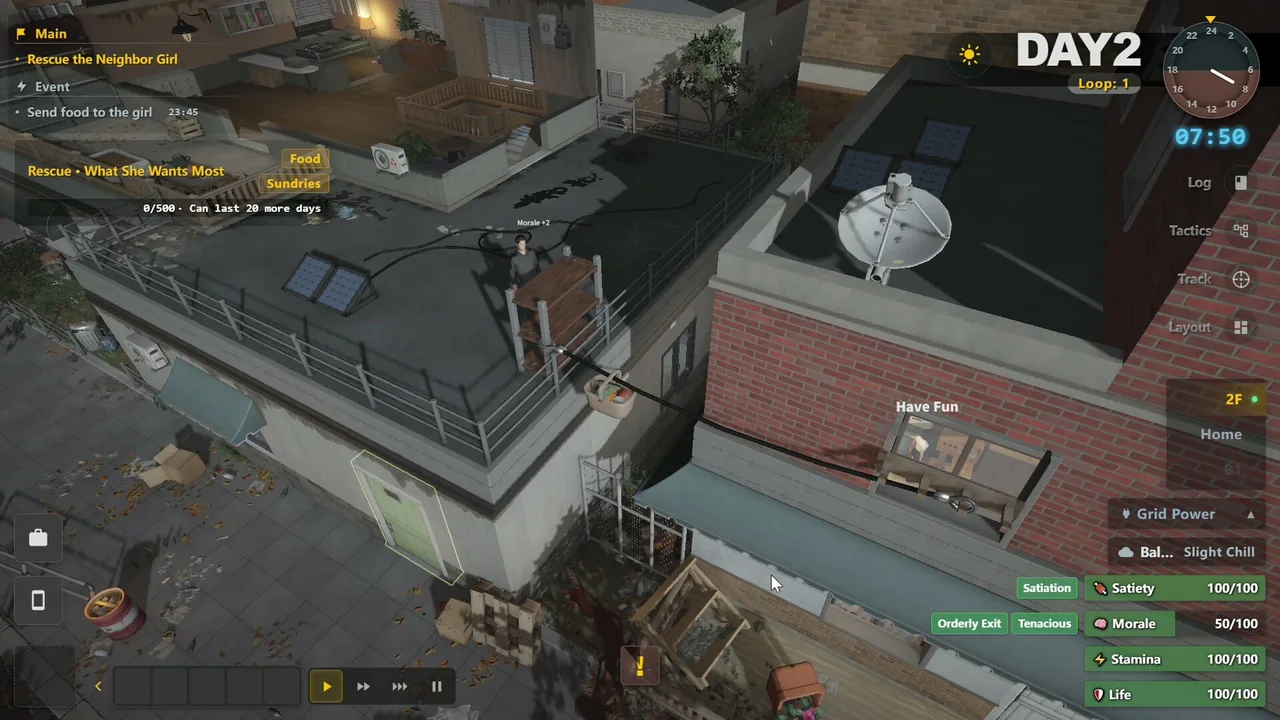
The clearest example is the neighbour rescue. By Day 2 the main objective reads "Rescue the Neighbor Girl", with a linked event to send food and a requirement tracked as a supply total. That is not a side distraction; neighbours and drone trading are how you get resources once going outside stops being viable. Details on the neighbours page.
Smaller Survival Log events run alongside - obtaining a paper airplane, reading a workbench manual, playing darts - and they exist to nudge you into systems you might otherwise skip. The workbench in particular is worth engaging with early, since crafting proficiency accumulates and gates better defensive items.
Day 7: the first Survival Log siege is a deadline, not a surprise
By Day 7 a Survival Log screenshot already shows a "Zombie Siege!" banner with the front door at 80/100. That number is the whole lesson: sieges begin chewing durability within the first week, well before most first-time players have finished thinking about defense.
Which means door and window work is not a mid-game Survival Log project. If you did not buy upgrades during prep, Days 2 to 6 are when you craft and install them. The durability values page covers what each tier actually withstands.
Days 10 to 20: the systems exam
This is where a Survival Log walkthrough stops being a schedule and becomes triage. By Day 16 the game is running staged events like "Undead Swarm! Part II" during rain, with security doors and windows taking sustained damage - one screenshot shows a Security Door at 120/155 and a Security Window at 100/130 mid-event.
Three Survival Log systems get tested simultaneously in this stretch, and they interact badly. Power has to survive rain and cold, which is where diesel beats solar. Food has to shift from bought stock to cooked and farmed output. Durability has to be maintained while you are also spending days on the other two. Runs that die here usually died at hour nine of the prep phase, when the fuel budget was set.
Days 20 to 50: repair cycles and the Survival Log run home
Late Survival Log days settle into a loop of reinforce, repair, cook, and hold. Traps take over from raw durability as the primary defense, because repairing a door every siege costs more daily actions than a trap that kills attackers before they reach it. See traps and the late sieges.
The Survival Log trap here is complacency in reverse: players who survived the mid-game often stop upgrading and start maintaining, which loses ground slowly. Sieges escalate; a defense that held on Day 20 will not hold on Day 40 unchanged.
Survival Log controls and hotkeys worth learning early
The Survival Log right-hand rail carries the tools you will use constantly - the Log itself, Survival Tactics, a tracking view, and Layout for editing your safehouse. Floors are switched with the vertical selector showing 2F, Home and Basement. Time is controlled with play, fast-forward and pause buttons at the bottom, and using pause aggressively while planning costs nothing.
The game does not publish a printed hotkey list, so treat the on-screen rail and the pause controls as your working control scheme until one is documented. Two habits pay off immediately in any Survival Log walkthrough: check the weather indicator beside the day counter before committing to an outdoor trip, and open the floor selector before crafting so you place things where they are actually useful rather than where you happen to be standing.
Survival Log FAQ: Walkthrough
How many days do you survive in Survival Log?
Runs escalate toward a major horde around Day 50, but the game gives nearer objectives first - one official screenshot shows a main objective reading 'Days Survived: 5/10', so early targets are short and concrete.
What is the first main quest in Survival Log?
Early main objectives include surviving a set number of days and rescuing a neighbour. A Day 2 screenshot shows 'Rescue the Neighbor Girl' as the main quest with a linked event to send food.
When do zombie sieges start?
Early. A Day 7 screenshot shows a 'Zombie Siege!' banner with the front door already at 80/100, and by Day 16 the game is running multi-part events like 'Undead Swarm! Part II'.
What should I do on Day 1?
Finish installing anything still boxed, take stock of what you actually bought, and establish the cooking and sleeping routine. Day 1 is for setting the rhythm, not for ambition.