
Survival Log Weather: Cold Waves, Rain and Blackouts
Quick answer
Weather in Survival Log is a power problem wearing a thermometer. A cold wave demands heating, heating demands electricity, and the rain that accompanies late sieges is exactly what stops solar panels producing it. Survive weather by sizing your fuel buffer for the worst stretch rather than the average, and by installing heat sources before the temperature drops.
What Survival Log actually tracks
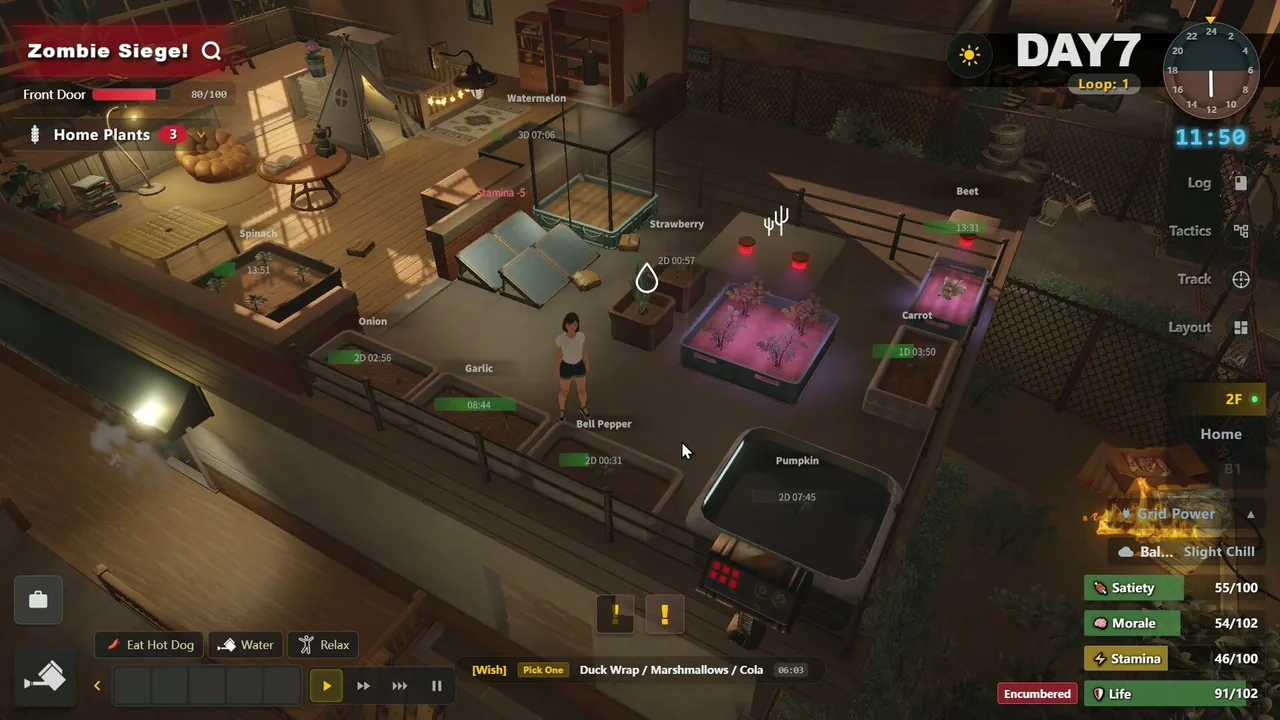
The Survival Log weather system is more granular than it first appears. Alongside the day counter and 24-hour dial, the HUD carries a weather icon, an environment state label, and a per-floor temperature readout.
| Indicator | Example value | What it tells you |
|---|---|---|
| Weather icon | Sun / cloud-and-rain | Current outdoor conditions, beside the day counter |
| Environment state | "Slight Chill", "Normal" | The ambient condition affecting your character |
| Room temperature | "1st Floor Room Temperature" | Per-floor interior climate |
| Grid Power | Powered / unpowered | Whether heating can run at all |
The per-floor detail is the one worth internalising. Because Survival Log heats floors independently, a safehouse spread across 2F, Home and Basement costs more to keep warm than one where daily activity is concentrated. That is a layout decision with a weather consequence, made days before the cold wave arrives.
Surviving a Survival Log cold wave
A Survival Log cold wave is not a single event to react to - it is a chain of dependencies that fails in order.
The cold wave is the clearest example of how the Survival Log systems interlock, and it fails in a predictable sequence:
- Temperature drops. The environment state shifts and interior floors start losing heat.
- Heating demands power. Air conditioning and heating appliances draw from the same grid as everything else.
- Solar output falls. Cold snaps in Survival Log tend to arrive with the overcast, rainy weather that suppresses panels.
- The buffer drains. Stored power and diesel deplete faster than usual, at exactly the wrong time.
- Morale follows. Cold, dark and poorly-fed is the compound state that collapses runs.
Every Survival Log intervention worth making happens at step zero. In practice that means an air conditioner or equivalent climate appliance installed and powered before the temperature moves - an air conditioner bought during the cold wave is a purchase you cannot make, since the shops closed on day one. Buy or unlock a heat source early, keep a diesel reserve you do not touch, and treat the first chilly reading as a warning rather than a curiosity.
Keep a quantity of diesel you refuse to spend on convenience running. A Survival Log cold wave that hits an empty tank is a run-ender; one that hits a protected reserve is an expensive week.
Survival Log rain, and why it is worse than it looks
Rain on its own is mild - it dampens solar output and makes going outside less appealing. What makes rain dangerous in Survival Log is its timing. Late sieges come packaged with it, so the weather that suppresses your power arrives with the event that most demands it.
Official footage of "Undead Swarm! Part II" on Day 16 shows precisely this: heavy rain, fires burning outside, and both a Security Door and a Security Window taking damage. A base running on solar alone in that frame has powered lights, heating and refrigeration all failing while the swarm is at the door.
Survival Log weather and farming
Crops in Survival Log grow on multi-day timers, visible on each planting box as countdowns like 2D 02:56 or 3D 07:06. That makes weather a farming problem too: an interruption to plant lights during a long cold, dark stretch does not just pause growth, it wastes the days already invested.
The mitigation is the same as everywhere else in Survival Log - power stability. Indoor grow boxes with plant lights are weather-independent as long as the grid holds, which is another argument for diesel as the backbone rather than the backup. See farming for crop timings.
Planning a Survival Log day around the forecast
The practical habit is simple: check the weather icon before committing a Survival Log day. A clear day is the right time for an outdoor trip, for solar-heavy activity, and for jobs that can wait. A cold or wet day is the right time for indoor crafting, cooking, and reinforcement work that does not care what the sky is doing. Matching the day's thesis to the forecast costs nothing and saves entire days of wasted Planning Points.
Survival Log FAQ: Weather
How do you survive a cold wave in Survival Log?
With heating you can actually power. A cold wave is a temperature problem that becomes a power problem, so the answer is a fuel buffer and a heat source installed before it arrives - not a reaction on the day.
Does Survival Log track temperature per floor?
Yes. The HUD shows readouts such as '1st Floor Room Temperature' along with environment states, so different floors of your safehouse can be in different conditions.
What are the environment states?
Screenshots show labels including 'Slight Chill' and 'Normal' beside a weather icon and the day counter. They summarise the ambient condition your character is currently exposed to.
Why does rain matter so much?
Because it cuts solar output and accompanies late sieges. Rain by itself is survivable; rain plus a horde plus a solar-only power setup is how well-built runs die.