
Survival Log First 10 Hours: The Prep Checklist
Quick answer
Spend the Survival Log first 10 hours on fortification and power before food, because doors, windows and generators cannot be improvised after the outbreak while calories can. A workable split is roughly 30% on doors, windows and defense, 25% on power and fuel, 30% on food and water, and 15% held back for cooking appliances and installation time. Weight, not cash, is the limit you hit first.
How the Survival Log prep clock actually works
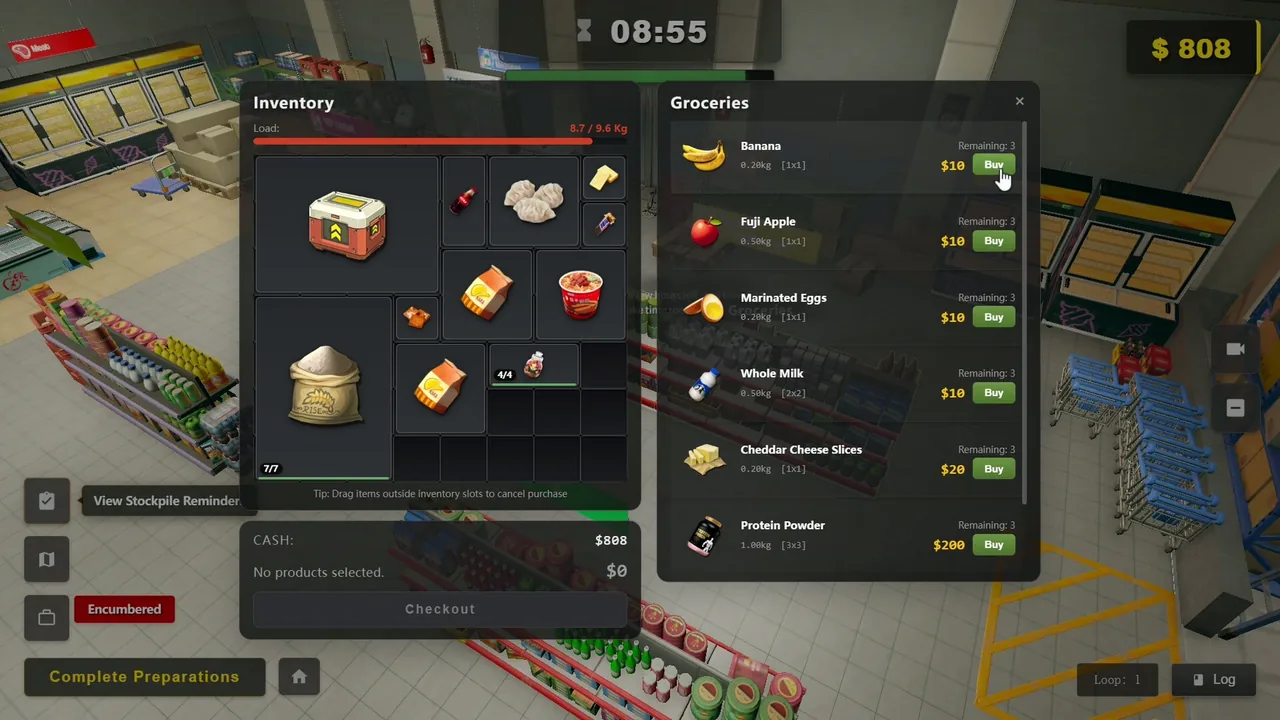
The Survival Log countdown sits at the top of the screen the whole time - official screenshots catch it at 08:55 and 04:45 with cash totals of $808 and $988 respectively. It runs while you travel between shops and while you browse, which is why routing matters as much as your list.
Four constraints operate at once during the Survival Log first 10 hours, and beginners usually track only one of them:
| Limit | How it shows up | What it punishes |
|---|---|---|
| Cash | Total shown top-right, e.g. $808 | Buying premium items early |
| Carry weight | Load bar in kg, e.g. 8.7 / 9.6 Kg, plus an Encumbered badge | Bulk-buying heavy goods in one trip |
| Home slots | Typed counters: SMALL 8/36, MEDIUM 10/31, LARGE 6/11, TABLETOP 5/9, BED 2/2, DOOR 2/1, WINDOW 2/3 | Buying furniture with no slot to put it in |
| Time | The countdown, plus per-item install times | Shopping right up to zero |
Screenshots show a DOOR counter reading 2/1 - owned versus available slots. It is entirely possible to buy a second security door with nowhere to install it. Check slot counts before you buy, not after.
Real Survival Log prices and weights
These figures are read directly from the Survival Log shop interface in official screenshots, so they are verifiable rather than remembered. They give you a sense of the price-to-weight economics you are working with.
| Item | Price | Weight / size | Verdict |
|---|---|---|---|
| Banana | $10 | 0.20 kg · 1x1 | Cheap calories, low weight |
| Fuji Apple | $10 | 0.50 kg · 1x1 | Same price, heavier |
| Marinated Eggs | $10 | 0.20 kg · 1x1 | Strong weight efficiency |
| Whole Milk | $10 | 0.50 kg · 2x2 | Grid-hungry for the value |
| Cheddar Cheese Slices | $20 | 0.20 kg · 1x1 | Cooking ingredient |
| Protein Powder | $200 | 1.00 kg · 3x3 | Expensive and bulky - skip on run one |
| Juicer | $10 | Tabletop slot | Cheap morale utility |
| Microwave | $20 | Tabletop · 30 W · installs in 1m 40s | Best early cooking value |
| Electric Oven | $120 | Small slot | Better cooking, real cost |
The Protein Powder line is the clearest lesson in the Survival Log economy: $200 buys a single 3x3 item. That is a fifth of your cash and a large chunk of grid for one consumable. The same money spread across eggs, bananas and a microwave feeds you for far longer.
A Survival Log cash split that works
| Category | Share | Why |
|---|---|---|
| Doors, windows, defense materials | ~30% | Cannot be improvised later; sieges are on a schedule |
| Power and fuel | ~25% | Blackouts cascade into food loss, cold and morale collapse |
| Food and water | ~30% | Buys time, and farming takes days to pay off |
| Cooking appliances | ~15% | Turns cheap ingredients into morale, not just calories |
This split deliberately front-loads defense over food, which is the opposite of most Survival Log advice you will read. The reasoning is simple: you can scavenge food in the early days when the streets are still passable, but there is no way to acquire a titanium-grade door on Day 12 when a siege is already chewing through the one you have. Read the door and window durability numbers before deciding how much of that 30% to commit.
Survival Log shop routing
Order matters as much as the list. Every minute walking between Survival Log shops is a minute not spent installing what you already bought.
- Home renovation store first. Doors, windows and building materials. These are the purchases that set your ceiling, and they need install time.
- Tool shop. Workbench materials and defense components.
- Discount supermarket. Bulk calories, and the busiest stop in Survival Log. Watch the per-item stock caps - "Remaining: 3" means you are building a varied pantry whether you wanted one or not.
- Farmers' market. Fresh produce and seeds if you plan to farm.
- Home, with time to spare. Install everything. Leave more of the clock for this than feels comfortable.
What to skip on your first Survival Log run
- Premium single items. Protein Powder at $200 and 3x3 is the archetype.
- Comfort appliances. Survival Log gives you coffee machines and brewers, but they are morale tools for a stable base, not a starting one.
- Wide food variety. Stock caps force some variety on you already; do not chase more.
- Anything you cannot install in time. An uninstalled purchase is worse than no purchase - you paid cash and carried weight for nothing.
One last habit worth building: before the clock hits zero, walk your house and check the typed slot counters. If your medium slots are at 10/31 while your food is sitting in a pile, you have bought the wrong shape of stockpile, and the Survival Log first 10 hours are the only chance you get to fix it.
Survival Log FAQ: Prep Phase
What should I buy first in Survival Log?
Fortification and power first, then food and water, then cooking appliances. Doors, windows and a generator are the purchases you cannot improvise later; calories can be topped up from scavenging in the early days, but a stock door cannot.
How much cash do you start with in Survival Log?
It varies by background and loop. Official screenshots show mid-prep totals of $808 and $988, so the starting figure sits in roughly that range before spending.
Why can't I carry everything I buy?
Survival Log enforces a carry weight in kilograms alongside a grid-slot footprint. Screenshots show loads like 8.7 / 9.6 Kg with an Encumbered warning. Weight, not money, is usually your first hard limit.
Do shops have limited stock?
Yes. Item cards show a remaining count - commonly three per item in the grocery list. You cannot solve a food shortage by buying twenty of one cheap item.
Should I spend all my money before the clock ends?
Effectively yes, but leave time rather than cash. Unspent cash is wasted value; unspent minutes are what let you finish installing everything you bought.